Sunday, February 15, 2004

Two ways to plan

Most large corporations seem to operate under the assumption that the best strategic plan is detailed, heavy on numbers, and tightly integrated to the expense budget. Although strategic planning was invented by the military a century before its adoption by corporations, very little of the insight into military planning has made it into the office tower.

Von Moltke wrote that "no plan survives contact with the enemy" and that strategy is "a system of expedients." This flexibility and acceptance of the unpredictable is anathema to the typical business planning process. All too often, we plan as though the we can determine what sales will be eighteen months from now, what expenses and what programs will produce those sales (by product and market).

In short, we think that the point of planning is to produce a plan that can be followed as though the organization is on auto-pilot. We want details, accountability, and milestones. And then we spend the rest of the year interpreting performance based on variance to plan.

This is not what effective planning is in the military. Colin Gray writes:


As General Dwight D. Eisenhower once observed, the principal value of military planning is not to produce ahead of time the perfect plan, but rather to train planners who can adjust and adapt to changing circumstances as they emerge.


Any business which wants to be more resilient and flexible would be smart to adopt the Eisenhower approach: planning as an educational process for people rather than a process for the production of the perfect plan.

Another problem with traditional planning is that it treats strategic problems as though they are entirely a matter of detail complexity. Yet, in reality, making and implementing strategy is a matter largely of dynamic complexity.

From Peter Senge's The Fifth Discipline:


The answer lies in the same reason that sophisticated tools of forecasting and business analysis, as well as elegant strategic plans, usually fail to produce dramatic breakthroughs in managing a business. They are all designed to handle the sort of complexity in which there are many variables: detail complexity. But there are two types of complexity. The second type is dynamic complexity, situations where cause and effect are subtle, and where the effects over time of interventions are not obvious. Conventional forecasting, planning, and analysis methods are not equipped to deal with dynamic complexity. Mixing many ingredients in a stew involves detail complexity, as does following a complex set of instructions to assemble a machine, or taking inventory in a discount retail store. But none of these situations is especially complex dynamically.


From John Sterman, Business Dynamics:


Most people think of complexity in terms of the number of components in a system or the number of combinations one must consider in making a decision. The problem of optimally scheduling an airline's flights and crews is highly complex, but the complexity lies in finding the best solution out of an astronomical number of possibilities. Such needle-in-a-haystack problems have high levels of combinatorial complexity (also known as detail complexity). Dynamic complexity, in contrast, can arise even in simple systems with low combinatorial complexity. ... Dynamic complexity arises from the interactions of the agents over time.


Competitive strategy is inherently dynamic: competitors react to each other's initiatives. Treating it as a matter of static analysis and programmed implementation is a recipe for failure.


Saturday, February 14, 2004

A point worth remembering

What's more, we should not forget that containment was failing. The shameful performance of the United Nations Security Council members (particularly France and Germany) in 2002-2003 was final proof that containment would not have lasted much longer; Saddam would eventually have reconstituted his WMD programs, although further in the future than we had thought.

That's from Spies, Lies, and Weapons: What Went Wrong by Kenneth M. Pollack You know, that Atlantic article which is so harsh on the Bush administration's handling of intelligence and the decision for war in Iraq.
Our Friends to the South

I don't know which is more disturbing: that spectators in Mexico taunted the US soccer team by chanting "Osama, Osama" . Or that the major media are determined to play down the matter. Details are at Rantingprofs.
Uncovered Story

Turn on a cable news network this week and you couldn't help hearing about Michael Jackson's finances and the $70 million dollar loan that is coming due. I'm not quite sure what the importance of that is beyond its gossip value.

I didn't see any discussion of John Kerry's impending financial crisis. See the Country Store for details. There are many "unanswered questions" about his campaign financing and the completeness of his financial disclosures. Somehow, those seem more important than what a pop star spends his money on.

Friday, February 13, 2004

That other scandal

Over at Roger L Simon:

I defended Clinton even when his lies got obvious (though I didn’t feel very good about it) and to this day I think Kenneth Starr is a creep out of Dickens.

Over three years after the Starr report and we are still working off the first draft of history as crafted by Carville and Blumenthal.

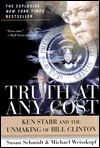
It probably wouldn't have caught my eye except that i've just finished The Truth at Any Cost which presents a much fuller picture of Starr and shows how wrong the caricatures were. Not that they let him off easy, but they show why he was a respected lawyer and what the OIC was up against.

Truth at Any Cost: Ken Starr and the Unmaking of Bill Clinton

I don't usually read Hugh Hewitt

but this is pretty good:

In short, most of "elite" media in America is practicing a steely resolve not to dignify the Kerry allegations absent some "proof," while relentlessy probing President Bush's ANG record of three decades ago. The hypocrisy is so enormous that it defies categorization, though not explanation: Standards for Beltway media differ when the "scandal" involves a man of the left than when it involves a man of the center-right.

"Gibson's 'Passion' in Very 'Select' Theatres"

That's the title of a very odd post over on Foxnews. Apparently, Roger Friedman thinks Gibson's film should be shown in theaters where it would lose money. Why this special requirement for this movie? Plenty of films open in carefully selected urban markets and never make it to the suburban multi-plexes.

What makes this opening strategy special is that it up-ends convention. Manhattan and LA are supposed to get first crack at all movies-- that's where buzz gets generated, that is where entertainment reporters hang out. For this movie, however, Gibson discovered that the audience was in the hinterlands and that they were primed and ready to go.

Clayton Cramer has a more thorough discussion here.

Thursday, February 12, 2004

Right on Target

Who cares who screwed Roger Partridge?

The Bloomsbury group bores me silly. Always has. All hat, no cattle—and that most definitely includes the only marginally readable Virginia Woolf. It’s the highbrow counterpart of the Algonquin Round Table, with better gossip and fewer one-liners. Now they’re all dead, and about time, too. The sooner they’re forgotten, the better for British literature.
Deeply Offensive

Jeff Jarvis plays Joe McCarthy with The Beltway Taliban.

Like Pinkerton, refuses to acknowledge that broadcasters ands cable companies are regulated businesses and always have been. They don't like the law on broadcast decency, so they don't want it enforced. If anyone is being undemocratic, it is the media libertines.

As for cable, while the content is protected by the First Amendment, their monopoly status and pricing policies are not. Forcing cable companies to adopt a la carte pricing, (instead of the prevalent package model), is not much different than allowing cell phone number portability. How does the First Amendment protect the right of Comcast to force a family to pay for MTV in order to get Fox News?

Oh, by the way, Jarvis's employer " has extensive interests in cable television" just in case you thought he was some sort of disinterested party.
Super Bowl Fallout

Ad Age has a couple of reactions to the Super Bowl ads and the half-time show. This one is not surprising:

PR FIRMS PRAISE JANET JACKSON BREAST STUNT
'It Raises the Bar for All of Us,' Says Executive

NEW YORK (AdAge.com) -- For those in the business of masterminding public-relations stunts for marketers, Janet Jackson's big expose during CBS's airing of the Super Bowl has raised a serious issue: how to top it.


I also like this reaction to the ads by Ad Age's editor:

AN ADVERTISING SUPER BOWL OF NON-IDEAS

Sophomoric Humor Fails as Compelling Entertainment

A flatulent horse. Tens of millions of Americans open their doors, and this is what marketers drag into their living rooms. A farting horse.

Yeah, thanks for coming. Don't let the door hit you on the way out.

Entertainment bowl

The Super Bowl, more entertainment spectacle than sporting event (despite this year's nail-biting finish), is a perfect platform for marketers to demonstrate how their messages can break through in a cluttered, fragmented and viewer-controlled media universe. As advertising moves from unwelcome intruder to invited guest, it is more likely to be cloaked as entertainment, as something viewers choose to spend time with because of a perceived intrinsic value.

The expectation is there with the Super Bowl that the ads will enhance the experience -- viewers have been conditioned by breathless segments of morning shows, newspaper stories and cable news reports to tune in as much for the ads as for the game. But there's a sense of artificial, forced frivolity that surrounds the event, and the mediocrity of the creative reminds that the ad business won't be saved merely by turning up the volume on 30-second commercials.

Wednesday, February 11, 2004

Uncovered News

One Hand Clapping notes that the terrorists in Iraq are concerned because our efforts to rebuild he Iraqi police forces are succeeding and that success is making their operations more difficult.
Since Everyone Seems to Be Doing It


create your own visited states map

Monday, February 09, 2004

We are way ahead of the curve

Outside the Beltway discovers that Kucinich is earning the respect of some pretty impressive guys. Hitchens says:

Dennis Kucinich is the sort of guy who we need in politics. He thinks long-term, and he doesn’t think that in the short or long term it pays to trade principles for compromises

Hey, that's sort of what we said back on Jan 19:

I feel sorry for Dennis Kucinich and am startled to realize that i feel a certain amount of admiration for the man.

On policy, the man is a complete moonbat. I doubt that there are many issues we agree on. But the man campaigned hard for his positions even though he knew the odds were heavily against him.
Carnival of the Capitalists

The latest edition is here.

Sunday, February 08, 2004

Hunter S. Thompson can die now

We have found his replacement.

Every Winter in Minnesota, 5 or 6 consecutive Friday nights of just ending up somewhere pile up on each other, into one King Hell bitch of a Friday, where a man is forced to make choices, not knowing whether the inevitably poor quality of those choices will haunt him at some odd hour, say 4am on Saturday morning, when he should have been in bed long ago, but is instead standing in a room where he's never been, with people he doesn't know, witnessing things he's only read about in books and seen between 40 minutes and 45 minutes past the hour on "VH1: Behind the Music."

That's Jack Sparks. If you like music you should be reading The Other Side of Country.

I have to thank Scott Chaffin for the pointer. And, by the way, Scott is bucking to be our Kerouac:

Here's how I'm gonna get rich -- I'm gonna organize 3-person trips to Minneapolis, and I'm gonna shove 'em in the truck, and I'm gonna drive them all the way there from Dullass, and we're gonna listen to two of my CDs for every one of theirs, and we're gonna get there early enough for everyone to have a nap, and we're gonna pick Jack up at his house, and we're gonna drink while driving and smoke Marlboro reds, and we're just gonna go and do whatever Jack says.

I wish i had said this

Patterico worries about the possibility that an innocent person might be executed every once in a while. So do I. If it happens, let's put the blame where it belongs: on Mike Farrell, Jesse Jackson, the Campaign to End the Death Penalty, and all the other little boys grown men who cried wolf.

Xrlq was discussing the posturing and lying going on around the Kevin Cooper case out in California.

On one hand, we are told that our death rows are filled with innocent men. Yet, when the anti-death penalty types bring out examples, the evidence often points to guilt. You would think that in high profile cases they would lead with their strongest examples.

Friday, February 06, 2004

Do Clothes Make the Nation?

What kids wear to school is not a trivial matter. Plenty of thoughtful people (Bill Clinton) think school uniforms are a good idea. Elite private academies and parochial schools have imposed dress codes and uniforms for decades.

The attempt by the French to bar Islamic dress is unsurprising. Since the Dreyfus case France has been relentlessly and aggressively secular. Catholicism was viewed with suspicion by most of the political class which was more anti-clerical than even-handed.

So, in a real sense, the French actions are not an anti-Islamic innovation. They are a continuation of the efforts that ensure that its citizens think of themselves first as Frenchmen, not as Catholic, Jew, or Muslim.

The French actions are not without historical precedent. Ataturk banned Islamic dress in Turkey after the overthrow of the Ottoman Empire in order to strengthen the new republic. Modernizing Tsars like Peter the Great forced Western ways on the Russian nobles (including western clothing) as part of their efforts to link Russia to Europe not Asia.

Habits of dress are often more important than politics and debate. David Gelernter understands this and makes the point repeatedly. In 1939: The Lost World of the Fair he shows how the "ought culture" of the 1930s was reinforced by little things on a daily basis. Among these were neckties which middle class men wore even when they were dining with their families at home.

Gelernter also makes an interesting point about Iran's frustrating diplomacy in the last decade of the Cold War. The mullahs aggravated both the US and USSR. The Soviet invasion of Afghanistan and the atheism of Leninism did not make them pro-American. The CIA coup and on-going support of the Shah did not make them pro-Moscow. A Middle East expert remarked that the first thing an Iranian Mullah noticed about the Americans and Russians is that both wore pants. Whatever the political differences between the two nations, they were united by culture- a culture the Iranian leaders did not share.
Lileks is wrong

I know it doesn't happen often, but it did this week.

Please no. I think I speak for millions when I say that I am deathly sick of the counterculture sixties. The music, the war, the protests, all the hagiography - it's not a reflection of the era’s importance but the self-importance of the generation who hung on the bus as it trundled along down the same old rutted road of history.. I’m tired of hearing about the boomers’ days of whine and neuroses; I’m weary of ritual genuflection to their musical icons; I’m utterly disinterested in most of the pop-cult trivia they hold so dear. We’ll probably be better off when that demographic pig has been excreted from the python so we can see the era clearly without choking on the smoke.

First of all, the 60s had plenty of crap music just like any decade. And plenty of it is over-praised. (Personally, i could live without ever hearing another Beatles song). But Hendrix is the real deal. If he is an icon, he deserves to be. Go pick on a more deserving target.

Second, Lileks is using a pretty broad brush. Yeah, some boomers are nostalgic for the protests. But it is always helps to remember that the guys in the rice paddies were mostly baby boomers. As are most of the generals you see on TV commanding the troops in Afghanistan and Iraq. But Abby Hoffman and Jerry Rubin were not boomers.

When all the boomers are dead, Lileks still won't get to see the era clearly. Sixties nostalgia isn't a generational thing; it is also political. If you are anti-military today, you think it is really cool that 500,000 people once marched on the Pentagon. There are millions of boomers who never thought it was cool then.

Thursday, February 05, 2004

"Complete Statement from Testimony of Lt. John Kerry to US Senate Foreign Relations Committee"

You can read the whole statement over at The Blog from the Core.
I liked this

From Hobbs Online:

An anonymous blogger might tell you he can't blog because his employer might not like it, or his customers - so just trust him that he is who he says he is. Hogwash. He just wants the freedom to behave badly, slander with impunity, and spread lies.

The Junk Yard Blog doesn't think much of anonymous bloggers either.
"NFL reaction to series a factor in cancellation"

ESPN.com

"Playmakers" has been sacked.

After months of speculation about its future, ESPN's originally scripted series about a fictional professional football team will not return, a company official said Wednesday. One of the main reasons for cutting the series after the first season was the reaction from the NFL brass.

"Many considerations went into this decision, not the least of which was the reaction from a longtime and valued partner," said Mark Shapiro, ESPN's executive vice president of programming and production. "We are proud of the show on many levels -- it was a creative and critical success, and we are appreciative that viewers clearly embraced this new genre on our network."

***

In its only season, "Playmakers" won critical praise and pulled in a significant audience -- an average of 1.6 million households for each of the show's 11 episodes.

***
ESPN broadcasts NFL games on Sunday night, and ABC -- which, like ESPN, is owned by the Walt Disney Co. -- televises "Monday Night Football." The rights deal for both broadcasts runs through the 2005 season.

Earlier in the just-completed 2003 season, NFL commissioner Paul Tagliabue admitted to calling Disney CEO Michael Eisner to express his displeasure with what he thought were the show's "one-dimensional" plots.


So the NFL really knows how to make their displeasure known. A series that tarnished the image of the sport (and hence hurt the brand) got Tagliabue involved. Which is a more forceful reaction than they had to the SB half-time show.

Makes me think this guy is right.

NFL must be high-fiving behind closed doors

The NFL is in perfect position here: It gets to tut-tut and claim the high moral ground that such a terrible, depraved thing could ever happen on our dime when in reality the holiness of the $2.5 million commercial spot is not only maintained, it probably is enhanced.

You think anyone is ever going to try to stage a Lingerie Bowl again? You think anyone's going to be stupid enough to take on the greatest god in television, the Super Bowl, with vague promises of pay-per-view titillation? The Super Bowl has already delivered the real thing, Bosco. It gave you The Other Jackson. There will be no one trying to upstage next year's halftime show


What's interesting is that no one suggests that there is an opportunity for clean counter-programming. Inside the little compound of media and advertising, there are no desirable consumers more conservative than Chandler on "Friends". They worry they will lose eyeballs to the Lingerie Bowl, but not that people will click away because of Nelly or Janet Jackson.

And this guy is probably right, too.

Expect more 'oops' on live TV

"There will be lots of public clamor," says Roger Desmond, director of the school of communications at the University of Hartford in Connecticut. And ultimately, nothing will change. "The networks will continue to do more of what they know works, which is big stunts," he says, particularly when they can be "positioned" as an unplanned surprise to everyone.
That Times of the Month

A new issue of The Atlantic.


Mark Steyn on Michael Straghit.

Christopher Hitchens on John Buchan.

Caitlin Flanagan on how serfdom saved the women's movement.

And much, much more. If you don't subscribe you really are missing the best magazine in America.

Wednesday, February 04, 2004

Rhetorical Three Card Monte

James Pinkerton warns us:

By now you've no doubt seen the implant-enhanced mammary that was exposed during the halftime show of Super Bowl XXXVIII -- destined to be known forever as the Boob Bowl. Strange as it may seem in light of the real perils this country confronts, Washington is making a federal case -- two federal cases, in fact -- over Jackson's bit of exhibitionism. Any investigation is farcical, of course, but the lasting damage it could do the First Amendment, and to free expression in general, is not something to laugh about.

To listen to the libertarian blogosphere, you would think that Powell and conservatives are trying to impose scary new rules on television. But that is a crock. The FCC has always forbid obscenity and indecency on broadcast television. Jackson threw down the gauntlet and they have no choice than to respond.

If the Pinkertons and others want to remove the rules against indecency, go to it. Get a Congressman to introduce the bill toremove restrictions on what goes out over the airwaves. Let's have a debate. (Watch your side lose 355-80).

But, at least, be honest. Don't pretend that Powell is the bad guy or that the "Repressive Right" is trying to impose new restrictions. Admit that you want the current rules changed. And tell us how much nudity, cursing, and rutting you are willing to permit on broadcast TV.

This is also good, although it has nothing to do with the SUperbowl.

Justin Katz has a thoughtful post here.

And OTB's Beltway Traffic Jam is here.
Den Beste is Right

The biggest story was the one we didn't read: "Terrorist attack causes 30,000 deaths". It is the deafening silence, the dog not barking in the night. For the third straight year since 9/11, a crowd the size of a small city concentrated itself in a stadium and sat for several hours to watch the most heavily televised live event of the year. And then that crowd dispersed and went home.

RTWT here.
There goes my faith in astrology

Acidman and i have the same birthday.

Tuesday, February 03, 2004

Humor is over-rated

It's invaded all the important areas of life. I can avoid the snarkfests on VH1 and the E network. I grit my teeth as it seeps into political coverage. (This is non-partisan: i'm as sick of Dennis Miller and the Dean video as I am of AL Franken and Arianna Huffington). I find the whole Wonkette thing lame.

But the breaking point for me was when it invaded sports. I started to avoid the football pre-game shows this season. Lame jokes and lamer skits have displaced reporting and analysis. Howie, Deion, Terry and Boomer crack themselves up but it just leaves me cold. And why have unfunny comics on to joke about something they know little about? If you can't fill an hour, just do a half-hour show and stop trying to be a comedy club.

As Aaron points out, humor is hard work and few do it well. Most of us should just not try.

I know, i know. The fool gets to say things to the king that no one else can. But look around: no king, no secret police, no Inquisition. We don't have to speak obliquely. Why waste time with a cheap joke when we have the ability to really say whatever we want.

Much of the joking around is a weasel's game anyway. It lets the smug but superficial camafloge their ignorance while retaining center stage. They don't have to defend what they say-- they were just joking. But they still are smarter than you.

Monday, February 02, 2004

Whither the Steelers

A 6-10 season is disappointing enough, but Pittsburgh has also racked up three losing seasons in the last six years. Obviously the team is looking as big changes.

Everyone is pretty much in agreement that Maddox disappointed and the running game ran out of gas. But there is a deeper problem. The Steelers roster is filled with one dimensional players. As a result, the play calling is predictable and easy for teams to game plan.

Under Cowher, the fullbacks and tight ends block for the running back. All three positions are unimportant in the passing game and the fullback is not a ball carriers.

When teams prepare for the Steelers they don't have to worry about misdirection in the ground game: Bettis can't get outside and the fullback isn't a threat on a counter play. Cover two isn't much of a problem because neither the TE nor the running backs can take control of the middle of the field.

The lack of break away speed also hurts. A well-executed draw or screen pass goes for 15 yards, not 40. Teams find it easy to bend without breaking.

What's striking is that this over-specialization is not "traditional Steelers football." When you look at the Super Bowl teams they were much more balanced despite the fact that they had greater position players. Nor is the Cowher system consistent with what great teams of this era have done.

This year only 25% of the passes went to RB/TEs. Bradshaw complete 40-50% of his to Harris, Cunningham, et. al. even though he had two Hall of Famers at wide out. The current Steelers have no one on their roster who fills the role that Novacek and Johnston played in the passing game for the Cowboys of the 1990s. Nor do they seem interested in full backs who can catch the ball despite the success the West Coast offenses have had for twenty years.

(Early in his tenure at Pittsburgh, Cowher had a fullback- John L. Williams-- who led the team in receptions. We won twelve games and came within four points and one play--fourth and goal from the three-- of the Super Bowl).

The Steelers also are exemplars of the simplification of the running game. Where teams once looked to have two capable running backs on the field at once (Taylor and Hornung, Czonka and Kiick) the system now calls for a blocking back and a feature back. Again, a uni-dimensional plan of attack that simplifies things for the defense. I've never heard or read a good explanation for why current backs can't learn to both block and run.)
Super Bowl Commercials

Wow. All that money and this is the best Madison Avenue can do? Farting horses and crippled old people? Earnhardt Junior in a football game?

If AARP wanted to do something really useful, they'd highlight advertisers who use senior citizens as objects of mockery. I doubt Frito-Lay or anyone else would want to deal with that counter-brand message.

I did thing the Pepsi/Jimi Hendrix and the Chevy/kids/soap spots were well done.
I would expect that someone got fired

Over the Janet Jackson half-time thing. A costume designer or a production assistant. Some one. Because we know that the executives at MTV and CBS didn't intend for this to happen.

SO who walked the plank?

Because if no one did, it looks fishy, you know. Makes you think the apologies are insincere.
Carnival of the Capitalists

Check out the latest edition here.
Hall of Fame

I don't mean to be greedy, but i think the Hall of Fame voters messed up by not selecting L. C. Greenwood. Then they rubbed salt in the wound by voting Carl Eller in.

Only two tackle/end tandems are in the HOF: Merlin Olsen/Deacon Jones and now Alan Page/Carl Eller. Yet the Fearsome Foursome never played in a Superbowl while the Purple Gang were 0-4. One might think that the 4-0 Steel Curtin deserved a second representative more.

Older players like Greenwood are hurt by sportwriters's obsession with statistics. Greenwood's sack totals are unimpressive by current standards (73.5 career, 11 in his best season.) But he played at a time when teams threw much less. In the early 70s teams passed around 360 times a season against him. Now 500 attempts is more common. Greenwood simply had fewer sack opportunities.

Before the game was opened up, the first job of a D-lineman was to stuff the run. No easy matter against guys like Csonka, Earl Campbell, or O. J. SImpson. Greenwood was a much better run stopper than Eller.

In four Super Bowls the Vikings got pushed around; they gave up an average of 215.5 yards rushing. (Franco Harris set a record with 158 yards against them in IX and Oakland piled up 266 yards in XI). In contrast, Pittsburgh held the Vikings to 17 yards on the ground despite having one D-lineman playing with pneumonia and losing two all-pro linebackers in the second half.

Fran Tarkenton said that Eller "was the dominant outside pass rusher of his day.? I guess Tark has blocked out the trauma of having three passes batted back in his face by number 68 in SB IX.

Sunday, February 01, 2004

Scott's Right

No Hall for Bullet Bob

Unreal. I thought this was the year, finally, that the Hall would pull their head out of where ever they have it lodged, but nope.

Like i've said before. Some people play the game well. Others, like Bob Hayes, change how the game is played.
Sharing the Joy

Venomous Kate makes a good point:

The thing is, it takes some bloggers - and non-bloggers, too - a long time to figure out that the more heavily we promote each others' blogs, the more we all succeed.

But this got me to thinking. While most of us bloggers are good at linking to other blogs, how good a job do we do bringing non-blog readers into the fold? I have to admit, i rarely send an email link to a blog post to friends or associates who are non-readers of blogs. Yet that is the bog opportunity. Readers only have time to read so many blogs: passing them back and forth can increase the "pie" only so much. Finding new readers could really juice up the audience for everyone.

Thursday, January 29, 2004

Blogging for Money

Matt Welch discusses the economics of Blog Ads here. While it is true that blogging is no way to make a living, the numbers are improving.

He also makes a good point about the importance of scale and critical mass:


Two other points, before I stop proselytizing for my friend Henry Copeland (http://blogads.com/weblog/): 1) Network effects will work very well here. The more participating blogs from Los Angeles, the easier it is for advertisers to make a useful, targeted group buy (and therefore pay me more money!). This also works for subjects -- media, baseball analysis, DIY music, whatever.


This is in line with something i wrote back in May

Right now newspapers are aided by their unchallenged dominance as a local advertising channel-- nothing else can really do the job when it comes to promoting a sale at a local department store store or specials at the grocery and nothing else can match newspapers for classified ads.

This advantage is eroding. Technology, demographics, and business necessity will see to that.

***

Eventually, on-line news sources and communities focused on specific geographic localities may provide a realistic alternative to local newspapers. If so, then they become a potential advertising vehicle.


In addition to the spot model for advertising, there is the old sponsership model.

Radio and television programs used to have a single commercial sponsor who picked up the costs, often owned the program and whose products were the only ones advertised. (That's why it's the Hallmark Hall of Fame and why daytime dramas are called soap operas). Echoes of the practice live on in PBS's underwriters.

The old model isn't a perfect fit with blogs because it would threaten bloggers's independence and creditbility. If Mazda sponsered Instapundit many people would dismiss his views on CAFE, Kyoto and the RX-8 out of hand.

But blogs have buzz and advertisers desperately want buzz. A couple of dozen advertisers are going to drop $3 million or more trying to generate some at the Super Bowl.

Which scenario is more likely to succeed in making Pontiac (say) appear more innovative: a Super Bowl spot or sending 10 bloggers to the Final Four? Factor in the cost differential (90% cost savings using bloggers) and the heavy odds against a given SB spot catching fire. The bloggers don't have to say anything nice about the Grand Am-- Pontiac generates favorable PR via traditional media just by underwriting the effort.
Kay Report and WMD

Justin Katz has two good pieces up: on at TCS and this one on his blog.
Clinton: A Conservative?

David Bernstein writes:

I was equally puzzled by conservatives' hatred for Clinton, who was probably overall the most conservative Democratic president of the twentieth century policy-wise, but also represented elements of cultural liberalism (draft-dodging, pot-smoking, womanizing, feminist-marrying, Hollywood-befriending, etc.) that drive conservatives nuts.

Clinton was conservative only because he lost control of Congress in 1994. If you look at the 1993-94 Clinton you find a very liberal agenda: gun control, gays in the military, national health care, tax increases. Even after 1994 Clinton fought against welfare reform and a balanced budget until political necessity and GOP resolve forced him to get on board.

Wednesday, January 28, 2004

Polls and Politics

If you want to get lost in the woods it's pretty simple: just look only a short distance in front of you and never look back. That makes it easy to go in circles while you think you are going in a straight line.

I wonder if our obsession with polls doesn't have the same result.

Would we draw the same conclusions about the Democratic race if we looked at it from the perspective of of July 2003 as do we do after looking at last weeks polls?

I doubt it.

From a longer perspective, one thing that stands out is the failure of the two moderate candidates, Gephardt and Lieberman, and the comparative success of two New England liberals. An angry insurgent did better than the champion of the UAW.

Edwards would be a surprise. Again, voters went for a new face, not one of the established leaders.

Is there any way that the results so far are not a set-back for the DLC. Doesn't that bode ill for the whole party in November?
Journalists and criticism

Instapundit makes a very good point:

"Is there any profession that's worse at admitting mistakes and taking criticism than the journalistic profession? "

The stereotype of the military is that they are constantly fighting the last war and are resistant to change. Yet, the various war colleges and service schools set to work analyzing Vietnam while the fighting was still going on. The mistakes and lessons were not swept under the rug. New doctrine was developed and all officers educated accordingly. All this happened while the draft was ended and the defense budget reduced in real terms.

My question is, how many J-schools focus on what went right and wrong with war reporting in SE Asia? Do any of them discuss how the military victory of Tet '68 was portrayed as a military defeat for the US and why this mistake was made? Do any of them remind students that it was an armored blitzkrieg from NV, not a peasant uprising which doomed Saigon in 1975?

I sometimes think that the biggest danger of war reporting is the journalist's selfish motive to be defeatist. Back in April i put it this way:

What is not often discussed is how professional ambitions make journalists defeatists. When wars go well, the uniformed military receives the praise. It is they who enter into history. We remember Nimitz and Patton, not the correspondents who wrote dispatches about the victories at Midway and Bastogne.

In contrast, Vietnam made the careers of David Halberstam, Seymour Hersh, and Neil Sheehan. Exposing military failure and atrocities makes the journalist the hero not the chronicler. It is a powerful temptation, one which could cause a reporter to lose proportion and distort the meaning of events. Yet this is not something that seems to get discussed much.
WMDs: Fooling the Dictator

NRO is apparently persuaded that Saddam wasn't such a terrible guy after all. That's the assumption behind this post.

If the scientists and generals could con him on WMDs, then he and his apparatus weren't very efficient. Moreover, it suggests that people in the know weren't "terrorized".

I've discussed this before and the reasons it seems fanciful.

Tuesday, January 27, 2004

"Kerry doesn't deserve Vietnam vets' support"

One sentence this piece in Opinion Journal really stood out:

In his book "Stolen Valor," B.G. Burkett points out that Mr. Kerry liberally used phony veterans to testify to atrocities they could not possibly have committed.

For a long time the popular media image of Vietnam veterans was as drugged out losers who were haunted by the atrocities they were forced to commit. Gullible journalists helped create this image by retelling the fictions of fake veterans. If Burkett is correct, Kerry was an early enabler of this big lie and willingly smeared his fellow veterans for political gain.

One can admire Kerry's service and bravery but still question the political opportunism of his post-war career.

UPDATE: This article has even more detail on Kerry's calculations and the scale of the lying.

Vetting the Vet Record


Fun Facts from the Statistical Abstract

Some people don't read reference books. I don't understand those people. How do they ever learn interesting stuff like this?

In 1999, Americans spent more on hunting equipment and firearms ($2.4 billion) than they did on equipment for camping ($1.3 B), alpine skiing ($0.6 B), tennis ($0.3 B) or in-line skating/skateboarding (($0.5 B).

Statistical Abstract

In the world of television, however, no one goes hunting except bad guys.

Monday, January 26, 2004

'For the Survival of Democracy'

An interesting new book on the New Deal. This is from the review in the Times:

''For the Survival of Democracy'' is a history of the New Deal in the spirit of the Democratic Leadership Council.

Hamby, a distinguished professor at Ohio University, knows exactly what he's doing here. The generation that created his field, he writes in an epilogue, ''established a tone that still dominates the study of American politics in the 1930's: a near-adulatory perspective, occasionally nagged by a sense that F.D.R. was too 'conservative' to lead us entirely into the promised land of equalitarian social democracy.'' He also notes the inconvenient fact that hobbles them: it's impossible to argue that the New Deal accomplished what it set out to do, namely, to produce a genuine economic recovery.

But it is not in answering the question ''Did it work?'' that Hamby ventures his most aggressive contribution to this discussion. He's more interested in what there was to admire in Roosevelt's attempt. He concludes: not too much.


I took several of Dr. Hamby's classes and seminars many, many years ago. He is a Truman scholar and was a conventional liberal: open-minded, not at all ideological. So this book is not some cut and paste hack job by a right-winger.

#ad #ad

Carnival

All politics all the time makes for a dull blogosphere. So check out the latest batch of posts on economics and business.

Saturday, January 24, 2004

Winner’s Curse

Synergy Fest has a series of interesting posts on Winner's Curse. I especially liked this one that relates the author's first hand experience with the phenomenon and its causes.

The commercial banking sector bought itself an expensive dose of the curse in the 1990s. As the industry consolidated, banks overbid for acquisition targets and hurt their balance sheets and stock prices. Exhibit A is usually First Union and Corestates, but there were many others.

What is interesting is that the banks who were hurt by overpaying in 1997-2000, were those who had been successful with an acquisition strategy from 1985-97: First Union, Bank One, NationsBank, etc.

I can think of several reasons why these banks stumbled:

1. Business as usual at an inflection point. In the late 80s, the bank acquisition market was not an auction. There were only a handful of regional banks doing the buying and numerous attractive targets. Under these conditions, winner's curse does not apply.

When conditions changed-- more bidders, fewer targets-- not many executives noticed. Growth by acquisition was still the strategy.

It's hard for any organization to reject a successful strategy based on the hypothesis that conditions have changed.

2. Go fever. Once top executives set their sights on an acquisition target, it is hard to hit the brakes. There is a powerful temptation to torture the numbers and make the pro formas support a higher price.

3. Grow or be eaten. When the assumption is that the industry is destined to have 3 or 4 megabanks, executives fear that standing pat means they will eventually become prey. This is a powerful incentive to justify a high bid for an acquisition which greatly enlarges their company.

While it is easy to see the problems today, most journalists and stock analysts promoted the acquisitions until the unfortunate results were manifest. One brave exceptions was Tom Brown who actually got fired because he spoke out against several expensive mergers. His company has a blog which makes for interesting reading for anyone interested in the financial services industry.

Side bar: Winner's Curse can also apply to the job market-- especially when firms hire outside executives for senior positions. The most enthusiastic candidates with the biggest promises is probably not the one with the best appraisal of the realities.
"Bush, Clark, Michael Moore and the charge of desertion"

The best discussion i've read so far is over at One Hand Clapping.
Good Point

Coyote at the Dog Show wonders why background checks are good for gun purchases but dangerous for airline travelers?

Thursday, January 22, 2004

One War at a Time Please

Report: Rumsfeld considers striking Hizbullah to provoke Syria

It may be nothing but speculation. But if not, it is worrisome.
Worth remembering

In the Spring 2002 issue of the International Journal of Intelligence and Counterintelligence, Robert D. Chapman shared a little history that explains some of our intelligence failures prior to 9-11. (Chapman is a retired CIA operations officer with covert experience.

"Back in the Cold War, a deep terrorist penetration agent reported that an (unidentified) commercial airliner was going to be hijacked. We knew if we blew the whistle, this valuable one-in-ten thousand agent would be blow sky-high."

The agency decided that they would only intervene if an American citizen was on board. None were and the plane was hijacked.

"Several years later a congressional oversight committee heard about the incident and reamed the agency until it hurt, "

Going forward, the agency would not have the option to protect an agent in this way. This could explain why we have a hard time getting inside the terror network.

Chapman also reminds us of the post-Watergate fallout:

"When the oversight committees learned of the Agency's support of the anti-Allende coup in Chile, there was hell to pay. Case officers following orders were threatened with criminal prosecution. To pay for their legal defense, homes were mortgaged and college nest-eggs robbed; good, competent officers quit over it. For an operation undertaken years before, they faced prosecution in an entirely different era."

CYA isn't always about avoiding embarrassment or advancing careers. Why would any young CIA officer take risks when he saw the punishment meted out to senior officers during the Church/Pike era?

In a similar vein, i have little sympathy for the pundits and nano-pundits calling for more aggressive special operations and condemning the military brass for timidity. When General Garrison displayed the old can-do spirit in Mogadishu, his career was destroyed because the operation turned into a public relations disaster.

Wednesday, January 21, 2004

Metropolitical

Jeff Jarvis declares:

There is no such thing as a pure Democrat and so I'm not one. There is no such thing anymore as a pure Republican and Robb's not one.

The parties play both sides of every street and so we, the voters, have to do the same thing.


I assume that he believes this is something new since he coined a neologism to describe it. But is was ever thus. Our parties have always been loose coalitions whose members disagreed with each other.

The Roosevelt coalition had liberals, urban machine loyalists, and conservatives in the South. Republicans in 1940 were both interventionist and isolationist, liberal and conservative.
In Praise of Bosses

The old machines which were so much a part of Democratic politics do not enjoy a good reputation. And there is not doubt that they were corrupt and small-minded throughout their history.

But they once did this country and the world a great service. In 1944 they forced FDR to drop Henry Wallace as his VP and put Truman on the ticket.

Wallace was a flake of the first order. But even worse, he was dangerously pro-Stalin. Among his closest advisors were men like Harry Dexter White who were Soviet spies.

It is hard to imagine what the post-war world would have looked like if Wallace had succeeded FDR in 1945. We can be sure that Wallace would not have taken the hard-line Truman did and that Stalin would have made even more gains than he did.

So hats off to the old-line bosses. For all their faults, they were right on the most important question in the world in 1944.
This is really odd


Family fears for famous scientist Stephen Hawking

THE world's greatest living scientist, Stephen Hawking, was in hospital yesterday under round-the-clock surveillance.

His family fear he is being earmarked by a deranged attacker who might try to sabotage the equipment and medicines that are keeping him alive.
Professor Hawking has pneumonia and has been in hospital since before Christmas.

Yet it is not the bronchial infection, serious in a 62-year-old man of such physical frailty, that is the chief cause of the terrors his family live with each day.

It is that the person intent on doing him grievous harm - and who appears to have succeeded in doing so already on numerous occasions - will go one step too far if not stopped soon.
Not a Positive Sign

Exodus of senior agents creates FBI 'brain drain'

Since the al-Qaida attacks on New York and Washington, more than three dozen senior-level agents, assistant directors and section chiefs have left the bureau in what some agents are labeling "brain drain."

More are likely to follow over the next year because the current 197 senior agents have an average service time of 19 years and four months. That is just eight months shy of the 20 years of service required for agents to retire with full pension benefits.

Tuesday, January 20, 2004

Sensible

I liked this from Dave Koppel in the Corner

The media is certainly capable of artificially inflating a trivial error into a disaster that can wreck a political career--as the media did when Dan Quayle used a spelling of "potato" that was proper in the mid-twentieth century, but which had become archaic by the 1990s. Howard Dean's speech to his supporters in Iowa last night strikes me as even less important, substantively, than "potato(e)." Dean struck a tone that's more typical of a college football coach than of a typical presidential candidate--but the speech hardly showed that Dean was going crazy, or having a breakdown, or any other mental problem.


"Pundits got it wrong"

From Howard Kurtz

In other words, just about everything you heard and read about the Iowa caucuses in November and December was wrong. Particularly those endless pieces about the importance of strong grass-roots organizations. The press would have done better if all the reporters had taken a long vacation.

The Fourth Estate has now gotten Dean wrong twice. Underestimating him in early 2003, overestimating him going into '04.
****

Now the same press folks who were wrong about how Iowa was going to break will tell you what Iowa means, how this scrambles the deck in New Hampshire, and so on.

For the next 48 hours, it will be all about Kerry is surging! Edwards is surging! Dean is fading!


And a good question from Lane Core

If pollsters can be so wrong the day before the event, when are they ever right except by coincidence? And why do we depend on them so much?

I think this might be a partial answer

The media love Iowa because it is a publicity gimmick that gives the networks huge clout over the nomination process. In 1984, Mondale got 48.9 percent of the vote in the Iowa caucuses and Gary Hart just 16.5 percent -- a three to one margin -- but the networks awarded Hart with a huge free publicity bounce that was his key to beating Mondale in New Hampshire the following week. In 2000, Steve Forbes had a much stronger second place showing (30.5% to George W. Bush's 41%), but the media ignored Forbes and lavished their attentions on Iowa-skipping John McCain, who rode the networks to victory in New Hampshire. It's the media caucus. Iowans get to merely participate.

Monday, January 19, 2004

Confession

I feel sorry for Dennis Kucinich and am startled to realize that i feel a certain amount of admiration for the man.

On policy, the man is a complete moonbat. I doubt that there are many issues we agree on. But the man campaigned hard for his positions even though he knew the odds were heavily against him. His showing in Iowa will provide fodder for Leno and Letterman and their imitators in the blogosphere. Yet, in the end, he-- not the jokers-- is the heir of TR. He went into the arena while they sniped from the cheapseats.

Kucinich took his case to the voters through retail politics. The guys mocking him on TV got their megaphone by knowing the right asses to kiss in New York and Hollywood. I know which one i think is more admirable.

I know that conservatives are supposed to be excited that Dennis Miller is pro-Bush and that Arnold won in California. But to tell you the truth, i'd swap both of them for a half dozen candidates willing to log the miles and endure the mockery while they carried the conservative message into (currently) inhospitable areas.

Justin Katz comments here.
Margaret Cho

Michele is right to condemn the Freepers for their vicious emails to Margaret Cho. But Cho is in no position to cry foul: her own words are as bigoted and hateful as the emails she received.

There is one difference. The loonies who attacked her speak for no one but themselves. Cho was a guest blogger for Dean and and a judge for Moveon.org's anti-Bush commercial contest as well as a headline act at their fundraiser.
The Politics Below the History

In the great pageant of liberal historiography, liberal/progressive presidents continually rout the forces of reaction. Jefferson's Democrats defeat Adams and the Federalists, Wilson defeats the Republicans, and FDR dominates politics for a generation.

What is seldom noted is that all these decisive "progressive victories" were entirely dependent on slavery and Jim Crow.

In 1800 Jefferson would have lost to Adams if the Electoral College tally reflected the free population of the states. The Virginian won because of the extra votes the southern states for for their slave population.

In 1916, Wilson won re-election with a margin of 23 in the Electoral College. Were it not for the votes of the Jim Crow South, he would have lost.

In the 1942 election, Republicans won 20 out of 25 Senate seats out the South. The Democrats held the House by a slim margin of 222-209. Nearly half of those seats came from the land of poll taxes, literacy tests, and voter intimidation.

FDR ushered in near total Democratic control of the Congress from 1933 until 1981. (They were the majority for 44 out of 48 years in both houses). But this dominance was not the result of a popular mandate for liberalism; it was entirely a function of Jim Crow elections. Outside the South, Republicans won a majority of House seats at least eight times in thirteen elections between 1938-1962.

Think i'll send this to OTB's Beltway Traffic Jam.
Carnival of the Capitalists

is up and can be found here. This week's edition is especially wide-ranging. Check it out.

Sunday, January 18, 2004

Why do i suspect

that Rush Limbaugh is smiling as he puffs a cigar right now?


Panthers 14, Eagles 3

Friday, January 16, 2004

Good use of a Super Bowl spot

I'm generally dubious of Super Bowl ads. They are expensive and high risk. But P&G has come up with an innovative way to use them that has a lot of merit.

P&G purchased one spot. They then had an internal competition among their brands and agencies to see which commercial would air.

(Charmin won.)

That's not a bad incentive. It probably stimulated an uptick in creative thinking across their product line as competition usually does. For a big company like P&G, that's a good return on an investment of four or five million dollars.
Intelligence Matters

Last night on PBS, Fronline looked into the Katrina Leung case. She is the Chinese double or triple agent who had affairs with two of her FBI handlers. They may have compromised some of the most important counterintelligence operations of the last 10 years (e.g. Wen Ho Lee). The show was really well done and the website is packed with information on the case.

Edward Jay Epstein has several new items up on his website.

Army scientists were unable to replicate the anthrax weapons used in fall 2001 attacks using tools available to a "lone nut" scientist.

The "paper trail" that the FBI believes confirms that Atta was in the US on 8 April 2001, not in Prague.

A discussion of Team B and the nature of intelligence analysis.

Junk Yard Blog wonders if there are dots that have to be connected with the OKC bombing. He has posted on this a few times and i like that he doesn't push beyond the facts. You won't find a full-blown conspiracy theory here, just questions that haven't been answered.

Thursday, January 15, 2004

"September 11 as a 'wakeup call'"

A very good, very thought-provoking post over at Turnabout.

It appears, in fact, that the effect of 9/11 has been to reinforce rather than reverse existing tendencies. That’s not surprising. The normal response to attack is to reaffirm basic principle.
Forgotten Men II

Around here everyone agrees that the Eagles's conversion of the 4th and 26 against the Packers is the greatest play in Eagles history. But it wasn't the most important. That honor should go to Chuck Bednarik's open field tackle of Jim Taylor in the 1960 championship game. That play stopped the Packers on the Eagles's 8 yard line as time expired and gave Philadelphia their last NFL title.

The amazing thing about that tackle is that Bednarik made it after PLAYING 58 MINUTES in the game. "Concrete Charlie" was the last of the two-way players. In 1960 he played center on offense and linebacker on defense. It is hard to imagine a tougher combination to play well at the same time: block Rosie Grier or Sam Huff when your team has the ball, fight off Jerry Kramer or tackle Jim Brown when you don't. A cornerback or receiver can take some plays off; a linebacker or O-lineman hits and gets hit on every play.

Bednarik played both positions on a championship team when he was 35 years old. That's a level of toughness that makes thugs like Ray Lewis look like kiddies.

Oh yeah. Before Bednarik went to college, he flew 30 missions over Germany as a waist gunner on a B-24. He earned the Air Medal with five oak leaf clusters.
Overkill

Apparently Donovan McNabb is the only NFL player who was ever criticized unfairly.

I say that because ESPN and our local sportscasters always bring up Rush Limbaugh when they talk about McNabb. Months later, and it is still cause for comment.

Wednesday, January 14, 2004

Outrage!

What do you mean Bob Hayes isn't in the Hall of Fame yet?

The best evidence of athletic greatness is when they have to change the rules to keep the game interesting because of your ability. That's why i think Wilt was a better basketball player that Michael Jordan. Same thing happened with the Doomsday Defense in Dallas and the Steel Curtain.

The next level is when you change the way the game is played. By that measure Bob Hayes deserves to be in--- teams went to the zone defense because of his speed and receiving ability. I know he has had personal problems in retirement--- big deal. Bullet Bob was one of the greatest receivers ever to play in the NFL.

Tuesday, January 13, 2004

Super Bowl Ads

A thirty-second spot in this year's Super Bowl is going to cost $2.25 million. That's a record and is up 7% over last year.

Given their high cost and the intense scrutiny they receive, breaking commercials on the Super Bowl is a high risk proposition. Get it wrong and you've tossed away a big chunk of this year's advertising budget.

There is also the danger of hyper-awareness. Viewers watch, evaluate, and discuss the commercials as commercials. The underlying product can easily get lost. Often advertisers end up making a "great commercial" rather than one that most effectively conveys their message.

Some companies have to advertise on the Super Bowl. Budweiser commercials are almost a tradition. New movies, because they have to build awareness quickly, can benefit from the huge audience. Most of the other advertisers are rolling the dice in the hope that they can catch lightening the way Apple did with the "1984" spot.

UPDATE: Justin Katz comments here.
"Defining and Achieving Decisive Victory "


A long paper by Colin S. Gray that is well worth reading.

A sample of his bracing clarity:

It is not entirely true to argue, for example, that a bad idea can only be defeated by a better idea. There are times, as from 1939 to 1945, when a particularly bad idea--Hitler's vision of a racially pure Thousand Year Reich-- needs to be shot.

He writes intelligently about the war on terror and the correlation of forces:

Technology is not a panacea. The attractive proposition that the United States currently enjoys an unassailable military technological lead which has sharply reduced the value of allies, and which can deliver decisive victory more or less to order, is fragile or wrong on all counts. Technology is only one of strategy's dimensions,
and it is by no means the most important.

***

Because war is not solitaire, even an excellent army may fail to deliver victory. Policy simply may ask too much of its military instrument, or it may hamstring military operations with damaging political constraints.


One way in which policy asks too much is to expect quick and decisive victories in modes of war where that is impossible. For example, a key factor in decisive victory is the enemy's willingness to admit defeat. That is one of the reasons guerilla wars are so hard to win.

In words attributed to Mao Tse-tung: There is in guerrilla warfare no such thing
as a decisive battle.


Similarly, German doctrine and strategy in 1941-42 failed because Stalin, unlike the French, refused to accept that crushing operational defeats were strategically decisive.
"A Great Conserative Filmmaker"

From City Journal, a nice appreciation of Whit Stillman.

In 1991—a bad year for culture, what with grunge, Oliver Stone’s JFK, and Boyz N the Hood—American filmmaker Whit Stillman, then 39, quietly released Metropolitan, the first of three witty, articulate social comedies that will prove as immortal as Hollywood’s golden comedies of the 1930s.

Monday, January 12, 2004

Blogosphere/Mote/Beam

So Roger Simon was dismissive of blogs on Meet the Press. The blog boomers are predictably irate.

Jeff B. in the comments alerts us to a rather numbnutty discussion of blogs on Meet The Press; transcript here. The choicest moment is Roger Simon (not The Roger Simon, Our Roger Simon, the one who comes up first on Google, but the Other Roger Simon, the Dead Tree Roger Simon) insulting us all, which is to say the audience he wishes he had

More people probably read Instapundit than Roger Simon's blog. But Simon's readers on paper (US News and op-ed pages) far outnumber any blog's readership. So i don't think he is insulting readers "he wishes he had." A buzzmachine endorsement would create an increase in readership so tiny that no analyst could find it inside of the noise of real life data.

Joanne Jacobs left a comment that is kind of funny when you step back and think about it.

Your analysis of the banality of Wrong Roger's prose was priceless. I call it "Look, Ma, I'm writing!" writing. And I hate it. "Fine writing" is usually a substitute for reporting or thinking. If the columnist has something to say, he or she just says it without any blowing snow.

When I was a columnist, I worked hard to have something to say in every column. They cut down trees to make newsprint to put out newspapers. I owed it to the trees to make their sacrifice meaningful.


I agree that Simon's columns are often banal. But that is hardly a dimension where the (traffic weighted) blogosphere does better. And the typical big political blog is hardly a place where new ideas or critical thinking carry the day. I stopped reading Sullivan and Kaus etc. because i realized i knew what they were going to say about almost any issue before i read them.

A few days ago Kevin Holtsberry astutely summarized the prevailing realities of political blogging.

what I am considering giving up is the back and forth commentary, fisking, ranting, and what have you that occupies your typical blogger. I just find myself having less and less to say about current events. And it is largely frequent and heated discussions of current events that give the Blogosphere its traffic. A good example of what makes me tire of the whole thing is this Calpundit post on Brooks and the Neocons. It is not so much his post, although it is that too, but the comments that drive me to despair. To me these comments are a microcosm of the larger phenomenon: angry accusations, smarmy asides, bald assertions, and people talking past each other.

This isn't to say that all blogs are like this. (Check out my blogroll; all of those blogs are excluded from this indictment). But good blogs that don't play by the rules--who don't rant, who post on subjects not on the front page of today's newspaper-- those blogs are rare and have trouble drawing traffic.

UPDATE: Hell in the Handbasket has some spot-on comments.
Carnival of the Capitalists

The latest edition is here.

Sunday, January 11, 2004

Good Point

From Colby Cosh:

One thing Easterbrook might have expanded upon in exploring our material condition, a thing that's fascinated me since my days awash in Edwardian and interwar newspapers, is the way that people used to die of infection, and of now-easily-treatable medical problems, so easily. The slightest scrape could do in a healthy adult until after the Second World War.

Saturday, January 10, 2004

Tribal Politics

From the American Spectator:

The substantive issues of this next election are going to be few and far between. Assuming the nominee is Dean and that Bush doesn't decide to quit while he's ahead, both candidates will tilt away from gun control, toward more entitlement spending, toward liberalized immigration policies, toward staying in Iraq, and against reducing the size of government. The issues don't matter nearly as much as either keeping or gaining power, if they matter at all.

Rather, the contrast is, for lack of a better term, tribal -- though the affinity is cultural rather than genetic. Red and blue state designations are still in use because different voters feel that that says something about who they are. If you want to see yourself as a progressive, affluent, educated type and you live in a red state, you're likely to gaze longingly at certain parts of the map.
Emubfa dxyltis rdunaqi

I've played poker before, but i read this and realized there are friendly games and then there is the world of serious poker players. Honestly, it is as if Scott is writing Esperento or Chaldean.

One more reason i will not be stopping in Vegas anytime soon.
What they mean by the right stuff

You have got to read this account of the Gimli Glider.

HT: Hell in a Handbasket.

Changes

Justin at Dust in the Light has redesigned his blog.

Friday, January 09, 2004

Trendsetters and Beer Drinkers

Interesting column in Ad Age on marketing to hipsters. The author likes the current Miller campaign (see why i disagree) because it appeals to the trendy consumers without seeming to target them. That sounds like marketing nirvana.

The column hits on one major problem with marketing to the hip.

Until recently, my drinking crony Dan -- a just-hip-enough Brooklynite who knew trucker caps were trendy before anyone else (but had the decency never to wear one) -- was a Pabst Blue Ribbon drinker. When I last saw him he had switched. Why the new brew, Dan? "I knew Pabst was over when I saw it in the [New York] Times," he half-joked.

This is tough on the Times. And it's unfair to Pabst, which has sustained a sales resurgence based on working-man brand values, scarcity and price. But it shows how easily an influencer can be turned off a brand by the knowledge that the masses are being turned on to it. Patrick Meyer, founder of marketing consultancy Fusion 5, is passionate on this. "Brands get hot and respond by turning up the volume with huge media buys," he says. "But blasting the public just switches the core consumer off."


It is a looking-glass kind of world where marketing success ("we're trendy") can immediately lead to failure ("that's so yesterday, everyone drinks it"). If the goal is to win over a lot of average consumers by being hip, what happens when the mass popularity drives away the "trend-setters"?

This type of marketing just seems self-defeating, not to mention overly complex. It depends on influencing a market segment with a veiled message so that they will create the main message that will drive purchases by the profitable segments.
Case Studies

One of the real problems with business education is the heavy use of prepackaged case studies. While they purport to hone critical thinking skills, they also impart false lessons. Future managers come to believe that the information in front of them is complete, reliable, and predictive. The only thing left to do is exercise some thinking and then make a decision.

In real life it will never be that simple. Numbers are shaky and dirty data is a persistent problem. In the beginning there won't be enough critical information on the matter at hand. At the same time , there will be a flood of trivial and irrelevant material that demands attention.

It is tempting to wait until more data and better data can be obtained. Unfortunately, time is often a critical competitive dimension.

Thursday, January 08, 2004

New Orleans

On this day in 1815, Andrew Jackson decisively defeated the British Army at New Orleans.

Robert Remini, in The Battle of New Orleans, wrote:


There was a time when the United States had heroes and reveled in them. There was a time when Andrew Jackson was one of those heroes, along with the men and women who stood with him at New Orleans and drove an invading British army back into the sea.


The victory was unexpected. The British had had the better of it in most of the land and sea battles and even burned Washington, DC. At New Orleans they had 8,000 regulars who were veterans of Wellington's army that had defeated the French in Spain. Jackson had only 4,000 troops most of whom were militiamen and recent volunteers.

Even more surprising was the lop-sided outcome. British losses were 291 dead, 1,262 wounded and 484 taken prisoner. The Americans lost only 55 KIA, 185 wounded and 93 missing.

We rarely commemorate the battle today, but for those who were alive in 1815 and for their children, it was a different story. Remini, again:


Americans in the first half of the nineteenth century did believe that January 8 would be remembered like July 4-- both dates representing the nation's first and second declaration of independence from Great Britain. Indeed some called the War of 1812 the Second War for Independence. Generally speaking, widespread observance of January 8 as a day of national celebration continued for the next fifty years.


Wednesday, January 07, 2004

Huh? Jeff Jarvis is discussing John LeCarre:

The only world le Carre could understand was the world of the cold war. Today's world, which really is about evil and good, is beyond him. He wants to complicate it. He wants to turn it into an overcomplicated fable. But it's not. Osama is bad. Saddam is bad. Blair is not. Bush is not. It's really rather obvious.
Which seems to imply that he thinks the Cold War was not about good and evil. Come on, more Poles died at Katyn Forest than the total deaths on 9-11-01. How is opposing Stalin and his heirs more complicated morally than the struggle with Iraq or al Qaeda?

Computer Models


Earlier i quoted Michael Crichton:

This fascination with computer models is something I understand very well. Richard Feynmann called it a disease. I fear he is right

Clifford Stoll cuts to the heart of why this is so:

Computers hide mistakes in logic while sanctifying information with an aura of truth.

(Sorry, i wrote down the quote but failed to get the proper citation. It's from several years ago, probably from Silicon Snake Oil.)

A model will spit out reams of information and data. It seems so concrete and precise: percentages are calculated to two decimal places.

Yet deep in the unseen guts of the model are a bunch of WAGs and SWAGs put there at 1.30 in the morning by analysts desperately trying to make their deadlines.
In Denial

FrontPage Magazine has a brief article on the non-reaction to John Earl Haynes’s and Harvey Klehr’s book.

Liberal mainstream publications largely ignored the book, with reviews mostly appearing in conservative newspapers and magazines, such as the Washington Times, Commentary Magazine, and the Weekly Standard.

***

The lack of reaction to In Denial is a reflection of the difficulty that anticommunist historians, such as Mr. Klehr and Mr.Haynes, have had in challenging the academic establishment on its assessment of American communism.

The piece is short and doesn't do justice to the research that went into the book. The authors show how the "revisionists" have obstinately refused to revise their conclusions about Stalinism, American Communists, and anti-communists despite a flood of new documents. Creationists do fewer contortions to hold onto their worldview.

Tuesday, January 06, 2004

Business Blogging

The latest Carnival of the Capitalists is here. Well worth checking out.
A quiz with a point

Found this via Ipse Dixit:

Holocausts of Communism Test

For the record, i scored as "an Advanced student of Communist atrocities." Just goes to show that reading the Reader's Digest can pay off.

Monday, January 05, 2004

Central Staffs

Corporate staffs, especially central planning staffs, have few defenders anymore. Since In Search of Excellence most businesses writers have come down in favor of decentralization and line units. GE used to have a large and powerful planning staff, but Jack Welch dismantled and dispersed it. Most turnaround CEOs have followed suit.

The critique of planning staffs argues that they just generate paper, distract line managers, and generally make the business slow to respond. Nearly every indictment of GM and Ford notes that they were hamstrung by the power of their Finance department while the Japanese ate their lunch.

This critique is largely correct in my experience. The plans and projects are bureaucratic exercises, not courses of action which yield marketplace gains.

But what i find intriguing is that it is a different story in the military sphere. The rise of the staff-- especially the general staff-- is a critical element in operational prowess and military effectiveness.

The German experience is the most studied. A strong general staff was a key part of the Prussian military reforms which revived the army after Napoleon crushed Prussia in 1805-06. It played a key role in the rapid victories in the wars of unification (1864-1871) and was the critical instrument in the development of the Blitzkrieg.

The importance of a general staff is almost universally accepted by military historians. Lee's failure to develop a modern staff is one of the causes for the CSA's defeat. Patton had a good staff which was why he could respond so quickly in the relief of Bastogne. The French general staff was the antithesis of their German opponents which explains many of their failures between 1914 and 1940.

I'll hazard a few reasons for the difference in performance of military and corporate staffs.

1. The best military staffs are made up of officers who previously served in line positions and know they will return to such positions. The worst corporate horrors seem to come from companies where the staff world can provide a career path (Finance, Audit, HR, etc.). Staff-line rotation serves to broaden perspectives and as a reality check.

2. The German staff officers were trained in the totality of war-- history, planning, tactics, leadership. All too often corporate staffs have a limited, specialized toolkit that they apply to every problem. Not every situation can be approached as a question of financial control or process reengineering.

3. General staff officers were selected after a rigorous screening process which looked at intellectual potential, past-military performance, and academic preparation. Combined with their service in line positions, this ensured that they were respected by the officer corps as a whole. Too many corporate staffs fail to win this respect and must rely on executive fiat to gain even minimal cooperation.

4. Business staffers generally operate with the assumption that the world is predictable. Most of their efforts are devoted to measuring, explaining, and eliminating variances. The German General Staff understood that war was unpredictable-- as von Moltke said, "no plan survives contact with the enemy."

5. Business staffs generally assume that they have the answer and success is just a matter of applying the right template. Often those templates and methods come prepackaged by consultants. The best general staffs serve a vital role in creating new doctrine by studying past operations and potential enemies. The US Marine Corps had worked through the problems of amphibious warfare by 1937, The roots of Blitzkrieg are found in von Seeckt's creation of 57 study groups tasked to analyze the 1914-1918 war. He did this in 1919 and assigned nearly 10% of the officer corps to this task.

See also,

Waiting for our Clausewitz


Clausewitz (II)
This deserves to be read in full

The John Dillinger Chair in Business Ethics?
Peter Drucker

Provocative as usual in this Fortune interview.

I believe you should outsource everything for which there is no career track that could lead into senior management. When you outsource to a total-quality-control specialist, he is busy 48 weeks a year working for you and a number of other clients on something he sees as challenging. Whereas a total-quality-control person employed by the company is busy six weeks a year and the rest of the time is writing memoranda and looking for projects.


Michael Crichton

Let me add my voice to the chorus. These two speeches by Michael Crichton are brilliant.

Aliens Cause Global Warming

I want to pause here and talk about this notion of consensus, and the rise of what has been called consensus science. I regard consensus science as an extremely pernicious development that ought to be stopped cold in its tracks. Historically, the claim of consensus has been the first refuge of scoundrels; it is a way to avoid debate by claiming that the matter is already settled. Whenever you hear the consensus of scientists agrees on something or other, reach for your wallet, because you're being had.

***

This fascination with computer models is something I understand very well. Richard Feynmann called it a disease. I fear he is right

Why Speculate?

Today, of course everybody knows that “Hardball,” “Rivera Live” and similar shows are nothing but a steady stream of guesses about the future. The Sunday morning talk shows are pure speculation. They have to be. Everybody knows there's no news on Sunday.

***

We need to start remembering that everybody who said that Y2K wasn't a real problem was either shouted down, or kept off the air. The same thing is true now of issues like species extinction and global warming. You never hear anyone say it's not a crisis.

Saturday, January 03, 2004

"Blogs vs. journalism"

Julie has a long and thoughtful response to Jessica's question mentioned earlier.

Friday, January 02, 2004

Favorite Posts

I've decided that these are my favorite posts for each month that i've been doing this:

March, History, Italy and the Nazis

April, Waiting for our Clausewitz

May, The Agony of the Agency

June, Good Old Boys

July, Rise of the Creative Class

August, The Miracle On The Vistula and Forgotten Men (Jim Ryun)

September, Better than fiction (Charles Goodnight)

October, Mission to Niger and a Cautionary Tale from Vietnam

November, Getting Hip to Squareness

December, Software

Taking Stock

I had originally started to put together a subject index for last year's posts. But it turned out that i had posted more than i thought and on too many topics. Still, it was interesting to go back and look at what i've written.

The first post was nothing special. And the plain fact is most of what ended up here had a pretty short shelf-life-- Janeane Garafolo? Michael Moore at the Oscars?

Over the year i got Instalanched, twice. I got drawn into blog controversies. I wrote a lot about Rick Bragg and the NY Times but took the unpopular side. Like a lot of bloggers i defended Gregg Easterbrook and i got ticked off about the Kobe Bryant case.

And, like many others i blogged about blogs and the blogosphere.

I planned to write more about business and marketing. I did write a fair amount about advertising. Somehow I also ended up defending Walmart repeatedly.

This post brings more visitors via search engines than anything else here.